For the last six decades, since 1973, Ibec has been involved with the All-Island business community, including through our Joint Business Council with CBI Northern Ireland, in facilitating the dialogue between business leaders in both jurisdictions. Our focus continues to be on leveraging the All-Island economy to promote strategic investment and the growth of employment and prosperity across the entire island.
The joint work of the business communities has constructively informed and supported the development envisaged in Strand Two of the Belfast Good Friday Agreement on North/South cooperation to develop trade, critical transport and infrastructure, skills, supply chains, regulatory regimes and markets in order that both jurisdictions would fully benefit from the scale of the All-Island economy. Businesses have long recognised that there were North/South opportunities of mutual benefit.Whilst progress on an All-Island economy is significant, there remains further opportunities of mutual benefit which the Irish business community will continue to pursue in the coming decades.
Tomorrow's Talent - All Island Workforce Report - Ibec CBI Hays


As we approach nearly 30 years of the Belfast/ Good Friday Agreement, the all-island economy has experienced a period of remarkable dynamism and growth. Since 2019, total employment across the island has surged by 550,000 jobs, a testament to the collective resilience and ambition of our businesses and workforce.2 Despite this success, the all-island labour market today presents a still untapped opportunity for both employers seeking top-tier talent and professionals looking to advance their careers. Recognising this evolving landscape, Ibec, CBI, and Hays have partnered to develop this major new work trends survey. Drawing on insights from over 1,200 respondents, including both employers and employees spanning across sectors and geographies, this report captures the pulse of the all-island economy, identifying the leading opportunities and practical challenges defining the future of work. Our findings reveal a workforce with a strong appetite for cross-border mobility, driven by the prospect of better career progression and higher wages. For businesses, an interconnected labour market offers a tangible solution to pronounced skills gaps, unlocking access to a broader, highly capable talent pool. There is therefore widespread optimism and preparedness for technological advancement, with employers looking to embrace the transformative potential of Artificial Intelligence (AI) and an agile workforce already experimenting with the day-to-day uses of AI.
UK-Ireland Summit - Joint Statement
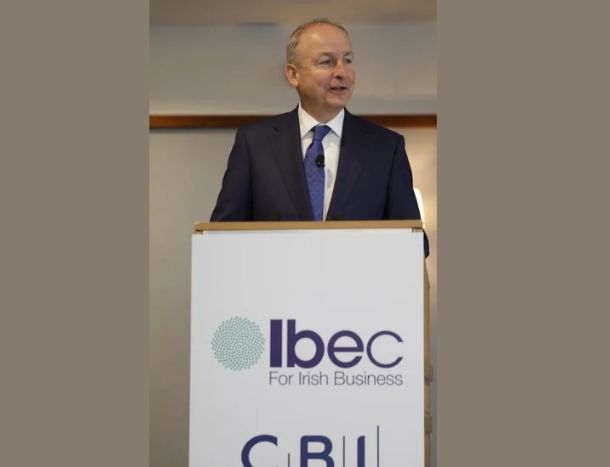
Ahead of the UK-Ireland Summit this year, Ibec and CBI issued a joint letter to UK Prime Minister Sir Keir Starmer and Taoiseach Micheál Martin, setting out their shared priorities. The Summit once again took place against the backdrop of an increasingly uncertain geopolitical and economic environment. This only underscores the importance of close cooperation between the UK and Ireland to ensure we deliver both growth and resilience, but most importantly, to ensure our economies are capable of withstanding future shocks.
CBI-Ibec ‘All-Island Labour Mobility: Obstacles & Opportunities’
In July, Ibec and the CBI published a paper outlining that cross-border work falls short of its potential due to various obstacles impacting both employers and employees.
The groups called on both the Irish and UK governments to work together to tackle the growing barriers facing hybrid and cross-border workers across the All-Island economy.
While the All-Island economy is underpinned by over £14.6bn (€17bn) in annual cross-border trade, the Ibec-CBI study found that outdated regulatory and tax frameworks are severely restricting firms’ ability to recruit, limiting competitiveness, and depressing growth potential.
ESRI and NIESR macroeconomic model for Northern Ireland
In 2025, the Economic and Social Research Institute (ESRI) and the National Institute of Economic and Social Research (NIESR), supported by Ibec, produced and published a report on a new macroeconomic model for Northern Ireland and the all-island economy. The report discusses the development of a model for the Northern Ireland economy and how it can be used to produce economic forecasts and to examine the potential impacts of economic policies and shocks.
The modelling framework allows us to examine the effects of economic policies, shocks and opportunities – both emanating from within Northern Ireland, on this island and between these islands and from the outside world – on Northern Ireland, Ireland, the all-island economy, the UK and the international economy. More generally, these exercises contribute to our wider understanding and knowledge of how the Northern Ireland economy functions. This capacity is further strengthened by the model’s compatibility with ESRI and NISER’s models.
Peace + Prosperity Campaign

Ibec's flagship campaign to mark 25 years of the Belfast-Good Friday Agreement to mark the 25th anniversary of the signing of the Belfast/Good Friday Agreement (BGFA) and demonstrate the importance of peace and stability in supporting economic prosperity.
All Island Energy Policy Report
This report, produced in collaboration with the Confederation of British Industry (CBI) Northern Ireland, calls on policymakers across the island and the UK to develop and pursue a more coordinated and ambitious effort to transition to net zero. According to the report, this transition should be underpinned by a new phase in energy collaboration and investment in shared infrastructure, including a recommitment to the Single Electricity Market.
The report highlights that the shift to net-zero offers a significant chance to enhance competitiveness, boost energy resilience, make energy more affordable, and generate sustainable jobs. However, challenges such as regulatory uncertainty, planning delays, skills shortages, supply chain constraints, and emerging energy security risks are impeding progress toward climate goals.